4 Best Camping Stoves 2026: Coleman vs Budget vs Backpacking Picks
Every camping trip has a moment of truth, and it arrives at breakfast. The tent survived the night, the air smells like pine, everyone’s in a good mood, and now eight people want eggs and coffee at the same time on whatever you brought to cook with. This is where the difference between a good camping stove and an optimistic one stops being theoretical.
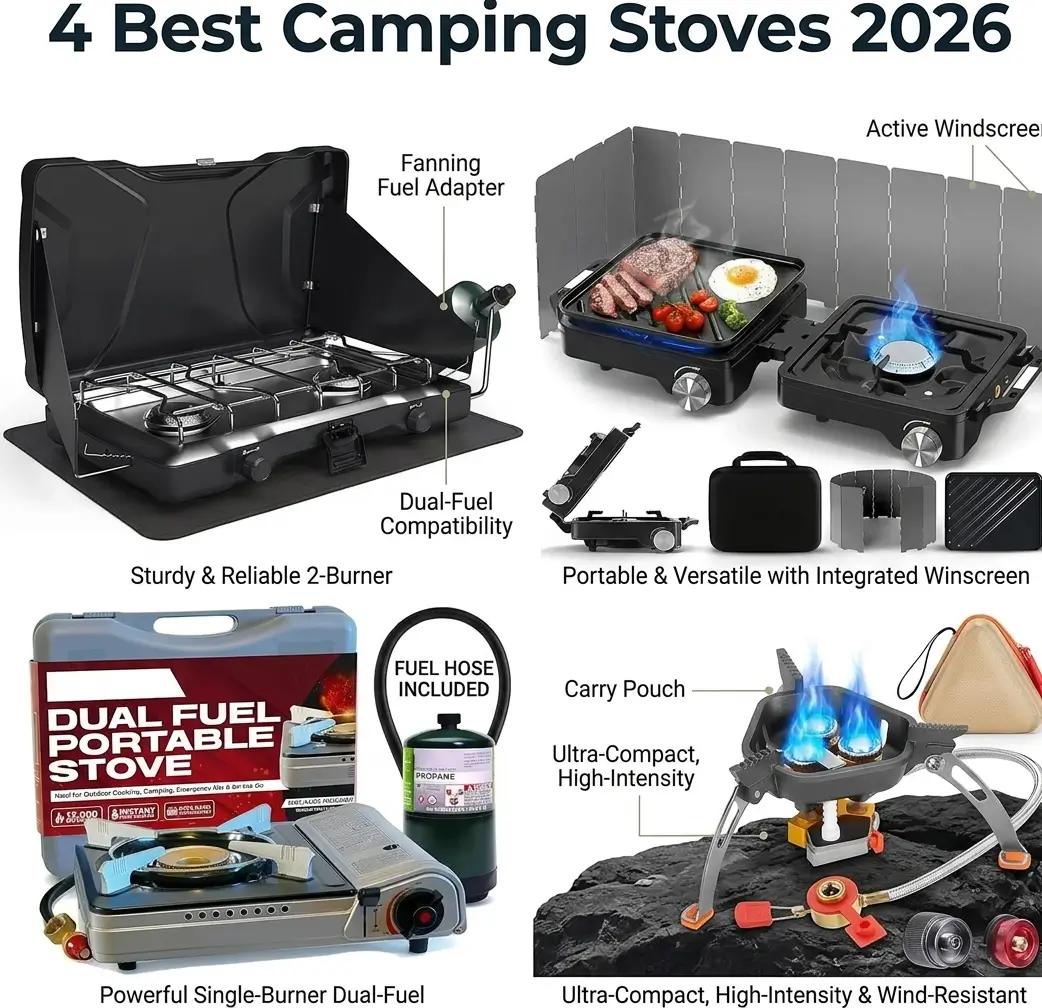
We compared four stoves that answer the question at four different scales: the Coleman Triton, the two-burner institution; a 24,000 BTU 2-Burner Pro that bundles a griddle and carry bag; the Grill Boss dual fuel, a single burner that drinks both butane and propane; and a palm-sized windproof backpacking stove for the trips where every gram gets counted.
Choosing a camping stove: cooking style beats spec sheet
The honest first question isn’t about BTUs, it’s about the menu. Real meals for a family, tagine-and-tea ambitions included, need two burners, because coffee and eggs refuse to take turns. Solo trips and couples car-camping do fine on one good burner. And anything you carry on your back needs the smallest stove that boils water, full stop, since backpacking cooking is 90% boiling.
About those BTU numbers: they’re honest, unlike flashlight lumens, but they’re also the least important honest spec. The difference between 22,000 and 24,000 BTUs is invisible in a pan; what actually separates a great camp stove from a frustrating one is wind protection (an unshielded flame loses half its heat to a breeze), simmer control (can it go low without dying, or does it only know “blowtorch”), and how the fuel question fits your region. Which brings us to the four:
- Coleman Triton: The known quantity. 22,000 BTUs across two adjustable burners, proper wind guards, and the build quality that’s kept Coleman on campsite tables for a century.
- 2-Burner Pro: The challenger with the bigger box: 24,000 BTUs, a folding design, and a griddle plate plus carry bag included, which is a real breakfast upgrade.
- Grill Boss dual fuel: One 12,000 BTU burner that accepts butane cartridges or propane (with adapter), piezo ignition, double wind guard. The emergency-kit and small-trip pick.
- 7200W windproof backpacking stove: Pocket-sized, screws onto gas canisters with two adapter options, piezo ignition, and a wind-resistant burner head. For hikers, not families.
1. Coleman Triton 2-burner propane stove

- PORTABLE: Easy addition to the campsite, picnic, roadside, and more
- TWO WIND GUARDS: Help shield and protect burners from wind
- HEAVY-DUTY LATCH: Easy to open and keeps the stove closed when not in use
The Coleman Triton is the camping stove your campsite neighbors probably have, and the unexciting reasons are the good ones. The two burners hold their settings independently, so the coffee simmers while the eggs fry hot. The side wind guards fold out and actually guard. The regulator keeps the flame steady as the propane bottle empties, which cheaper stoves conspicuously fail at, hence their sudden mid-pancake power fades.
What you give up against the challenger below: no included griddle, no carry bag, and you’ll light it with a lighter, since this trim lacks piezo ignition. Coleman sells those extras separately at Coleman prices. What you get instead is the near-certainty that this exact stove still works in fifteen years, because millions of its ancestors demonstrably do.
Pros
- Two genuinely independent, adjustable burners with real simmer control
- Pressure regulator keeps output steady as the tank drains
- Coleman durability and spare-parts availability
- Fits two 10-inch pans side by side
Cons
- No piezo ignition at this trim; bring a lighter
- No bag or griddle included
- Propane-only, so no cheap butane cartridge option
Best for: families who camp every season and want the stove decision made once, correctly.
👉 Check the Coleman Triton’s current price on Amazon
2. The 24,000 BTU 2-Burner Pro

- 【24000Btu High-Powered Double Burners】This Camping Stove with two independent 12000 BTU burners, this propane camp stove…
- 【Ultra-Portable With Carry Bag】This 2 Burner Camp Stove features a space-saving foldable structure ,Effortless Magnetic …
- 【Complete Outdoor Cooking Kit】Camping stove set includes everything you need: a 2-burner camping stove, a wind shield, a…
This 2-Burner Pro plays the classic challenger strategy against Coleman: match the core, stack the box. Slightly more rated power at 24,000 BTUs, a folding format that packs flatter, and the two accessories Coleman charges extra for, thrown in: a windscreen griddle for the pancake-and-msemen side of camp cooking, and a carry bag that keeps the soot off everything else in the trunk.
The honest trade is longevity confidence. A generic camp stove at this price with this kit is excellent value in years one through three; whether it’s still lighting evenly in year ten is a question its brand can’t answer yet and Coleman can. For occasional campers, that’s a trade worth making with a smile; the griddle alone upgrades more breakfasts than the extra 2,000 BTUs ever will.
Pros
- Griddle and carry bag included: real value, not padding
- Folds flatter than the Coleman for tight trunks
- Highest rated output here, with wind screening
Cons
- Unproven brand lifespan next to the Coleman
- Simmer control on generic valves is coarser; low heat takes practice
- Warranty support is a listing promise, not a service network
Best for: value hunters and occasional family campers who’d rather get the griddle and bag than pay for a badge.
👉 Check the 2-Burner Pro’s current price on Amazon
3. Grill Boss dual fuel single burner
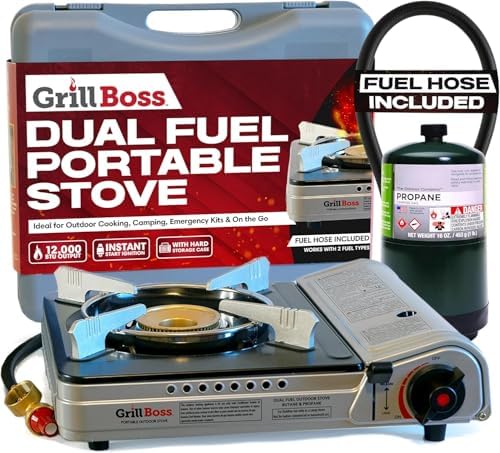
- VERSATILE DUAL FUEL CAMP STOVE, BUTANE & PROPANE COMPATIBLE – Enjoy flexible outdoor cooking with this dual fuel portabl…
- BUILT-IN SAFETY FEATURES FOR CONFIDENT COOKING – Cook with peace of mind using our single burner propane stove for campi…
- SIMPLE IGNITION & SAFE OPERATION – Light your propane camp stove with ease using the intuitive ignition system—just atta…
The Grill Boss answers the question that strands travelers: which gas will I actually find? It burns cheap, everywhere-available butane cartridges by default and switches to propane with the adapter, which makes it the stove that always has a plan B. One 12,000 BTU burner, push-button piezo ignition (no lighter hunt), and a double wind guard around a burner that sits low and stable on any table.
Its natural habitat is honestly split between the campsite and the kitchen cupboard. As a camping stove it suits one or two people; as an emergency stove during a power or gas outage it’s arguably the best pick in this article, because butane cartridges store for years, cost little, and swap in seconds indoors with ventilation. A lot of these get bought for the trunk and end up guarding the household against blackout dinners.
Pros
- Dual fuel: butane or propane, whichever the shop has
- Piezo ignition, the convenience everyone learns to love
- Compact, stable, and excellent as an emergency backup
Cons
- One burner: family breakfast becomes a relay race
- 12,000 BTUs is half the two-burners’ output
- Butane weakens in real cold; switch to propane below ~5°C
Best for: couples, solo car campers, and every household’s emergency shelf.
👉 Check the Grill Boss’s current price on Amazon
4. The 7200W windproof backpacking stove

- 【High Quality Material】Compared with stainless material of other brand, the burner of our camping stove is made of brass…
- 【Upgraded Design】The ignition needle position plus a baffle so that it’s easier to ignite the gas. The backpacking stove…
- 【Wider Cooking Area and Widely Used】With the support arm unfolded, our camping gas stove has a wider cooking area(Diamet…
This windproof backpacking stove weighs about as much as an orange and lives by one metric: minutes to boiling water on a windy ridge. The burner head’s tight flame pattern resists gusts that would strangle an open burner, the piezo button lights it with cold fingers, and the two included canister adapters solve the standing headache of hiking abroad, where the “wrong” gas canister format is a rite of passage. A carry case keeps the threads clean in your pack.
Understand what it is: a water-boiler and one-pot-meal machine for one or two people. Perched on a small canister, it demands flat ground and a modest pot; it will not hold the family paella pan and should never be asked to. Judged as what it is, it’s the item on this list most likely to summit a mountain.
Pros
- Pocket-size and near-weightless in a pack
- Wind-resistant burner keeps boil times sane outdoors
- Two canister adapters cover international fuel formats
Cons
- Small pots only; tippy with anything wide
- Canister gas costs more per meal than propane or butane
- One burner, one person’s dinner at a time
Best for: hikers, cyclists, and minimalist travelers measuring their kitchen in grams.
👉 Check the backpacking stove’s current price on Amazon
Propane, butane, or canister: the two-minute fuel guide
Fuel choice quietly decides which camping stove you’ll be happy with, so here’s the short version. Propane is the family-camping default: cheap per hour of cooking, works in cold weather, and the green bottles are everywhere in camping regions. Its downside is bulk; the bottles are steel and take trunk space. Butane cartridges are the opposite: slim, light, cheap to buy one at a time, sold in supermarkets across the world, and they underperform in the cold, sputtering as temperatures approach freezing. Threaded hiking canisters (usually a propane-butane mix) split the difference with the best weight and cold performance, at the highest price per meal.
Map that to the four stoves and the matrix explains itself: the two-burner pair drink propane for cheap family cooking, the Grill Boss hedges across butane and propane for flexibility, and the backpacking stove pays the canister premium to save your shoulders. There’s no wrong fuel, only a wrong match with how and where you cook. If you camp in the mountains in spring, weight cold performance heavily; if you cook for six on a July beach, price per hour wins.
Side by side
| Feature | Coleman Triton | 2-Burner Pro | Grill Boss | Backpacking stove |
|---|---|---|---|---|
| Burners | 2 | 2 | 1 | 1 |
| Output | 22,000 BTU | 24,000 BTU | 12,000 BTU | 7200W (~24k BTU class) |
| Fuel | Propane | Propane | Butane + propane | Canister (2 adapters) |
| Piezo ignition | ✗ | ✗ | ✓ | ✓ |
| Included extras | — | Griddle, bag | Wind guard | Adapters, case |
| Carries in | Trunk | Trunk | One hand | |
| Check price | Amazon | Amazon | Amazon | Amazon |
Which camping stove should you buy?
By trip type, since that’s what decides it. Family car camping several times a year: the Coleman Triton, and stop thinking about it; the regulator and the simmer control are what you’ll appreciate on trip twenty. Family camping on a budget, or a first two-burner: the 2-Burner Pro, whose bundled griddle will see more use than any spec on this page.
One or two people, or a smart addition to the emergency shelf: the Grill Boss, whose dual-fuel flexibility is worth more than a second burner you wouldn’t light. And if the kitchen rides in a backpack, the windproof canister stove is the only sane answer here; everything else on this page would feel like carrying furniture up a mountain.
Whichever camping stove you pick, run it once in the yard before the first trip. Every stove has a small personality, where its simmer point lives, how it likes to be lit, and a campsite at dusk with hungry kids is a bad classroom.
FAQs
Can I use a camping stove indoors during an emergency?
Only with serious ventilation, and ideally not at all. Burning gas produces carbon monoxide, which is odorless and kills quietly; every winter storm season proves it again. If a blackout forces the issue, use a butane stove like the Grill Boss near a wide-open window, never in a closed room, never while sleeping, and never a charcoal anything indoors under any circumstances. Outside on a balcony is always the better answer.
How long does a fuel bottle actually last?
A standard 465g propane bottle runs a two-burner camping stove for roughly 1.5 to 2 hours at full blast, and a full weekend of normal meal cooking at mixed settings. A butane cartridge gives the single-burner Grill Boss about 1.5 to 3 hours depending on flame. The rule of thumb that never fails: bring one more bottle than the math says, because the math never met your kids’ hot chocolate demands.
Does wind really matter that much?
More than any spec on the box. A moderate breeze can steal half an unprotected flame’s heat, doubling boil times and draining fuel; that’s why every camping stove here ships with guards or a windproof head. Position the stove with its back to the wind anyway, and on bad days a vehicle or a rock does more good than 10,000 extra BTUs.
How do I clean and store a camping stove?
Wipe spills while the stove is warm, not hot; dried tagine is geology. Once cool, soap and water on the grates, a damp cloth on the body, and make sure the burner ports aren’t clogged with sauce or insects before storage, a toothpick clears them. Store with fuel disconnected, in the dry, and the stove will hibernate happily until spring.
Why is one stove rated in watts and the others in BTUs?
Different markets, same physics: one BTU per hour is about 0.29 watts, so the 7200W backpacking stove sits in the same output class as the big two-burners, roughly 24,000 BTU. The number describes maximum gas burn, not cooking quality; a windproof 7200W burner often boils water faster outdoors than a nominally stronger open burner, which says everything about how much the wind guard matters.