4 Best Portable Power Stations 2026: Jackery vs EcoFlow Compared
The power went out in our neighborhood for six hours last winter, and I learned two things: my phone’s flashlight is not a lighting plan, and the neighbor with the portable power station was suddenly the most popular man on the street. His fridge hummed along, his router stayed up, and his kids watched a movie while the rest of us rationed phone batteries and stared at the dark.
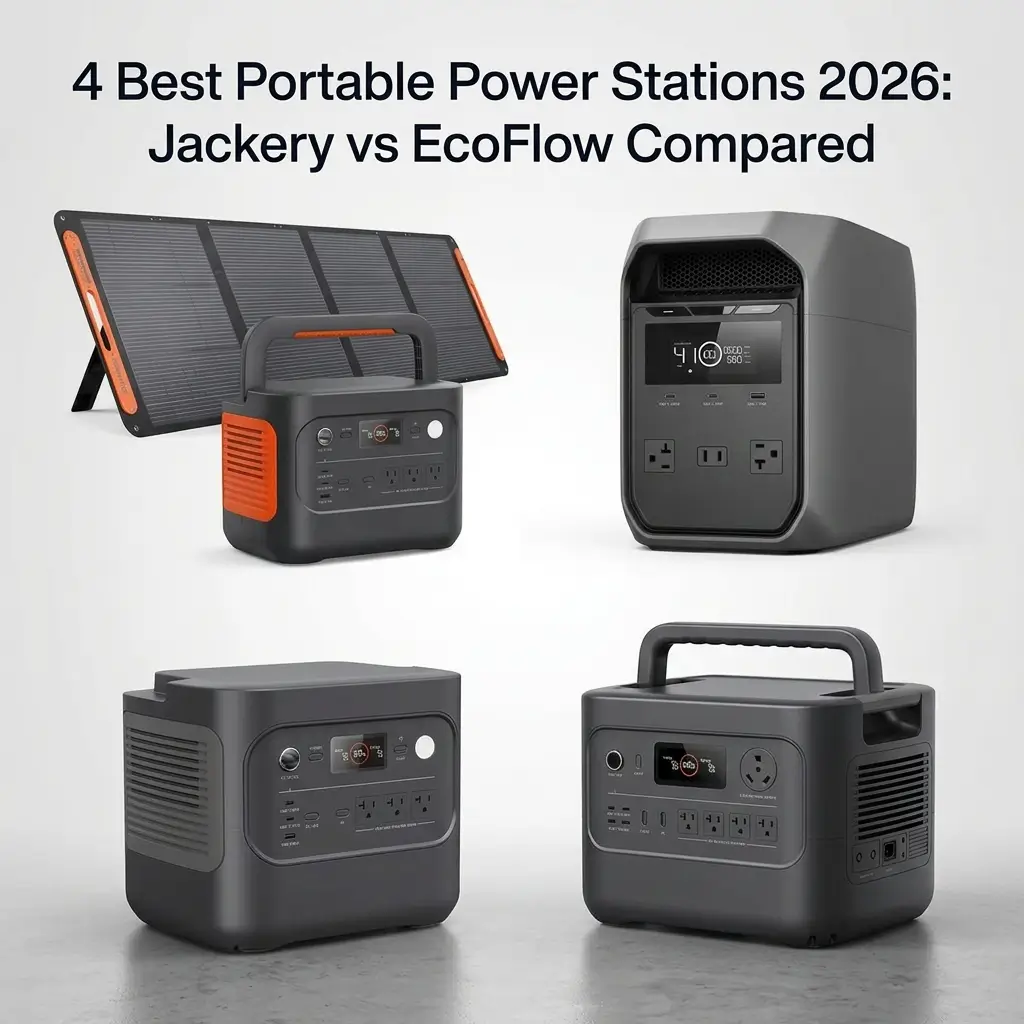
A portable power station is a big battery with wall outlets, and the buying decision is mostly one question: how many watt-hours do you need? To answer it, we compared four popular options that ladder neatly from small to serious: the Jackery Solar Generator 1000 v2 (1070Wh, with a 200W panel), the EcoFlow DELTA 3 Classic (1024Wh), the Jackery Explorer 2000 v2 (2042Wh), and the Jackery HomePower 3000 (3072Wh, bundled with two 200W solar panels). All four run modern LiFePO4 batteries, and all four link to their listings through our reviews section picks.
How to size a portable power station (the only math you need)
Two numbers describe every power station, and people mix them up constantly. Watt-hours (Wh) is the tank: how much energy is stored. Watts (W) is the pipe: how much power can flow out at once. A 1024Wh unit with 1800W output can run a 1500W kettle, but only for about 40 minutes before the tank is dry. A fridge is the opposite: it only draws about 150W on average, so the same unit runs it for roughly six hours.
So the sizing rule is simple. Add up the average draw of what you’d actually plug in during an outage (fridge ~150W, router ~15W, laptop ~60W, some LED lights ~20W: call it 250W), multiply by the hours you want to survive, and add 20% for conversion losses. An evening outage needs ~1000Wh. A full day needs 2000-3000Wh. That’s the whole framework, and it maps exactly onto these four machines:
One more spec worth a glance before the reviews: surge watts. Every portable power station lists a continuous output and a surge figure, and the surge decides whether a fridge compressor or a water pump starts at all, because motors briefly pull two to three times their running draw at startup. If anything with a motor is on your outage list, make sure the surge rating comfortably clears it. And if you plan to lean on panels, remember a solar generator is only as good as the sun your balcony actually gets.
- Jackery 1000 v2 (1070Wh): The evening-outage and camping unit, sold as a solar generator bundle with a 200W panel included.
- EcoFlow DELTA 3 Classic (1024Wh): Same tank size as the Jackery 1000, but with 1800W output and a one-hour wall recharge, the fastest here.
- Jackery Explorer 2000 v2 (2042Wh): The overnight unit. Double the tank, 2200W output, still one person can carry it.
- Jackery HomePower 3000 (3072Wh): The home-backup rig. 3600W output with a 7200W surge, two 200W panels in the box, sized for multi-day outages.
1. Jackery Solar Generator 1000 v2 (1070Wh + 200W panel)
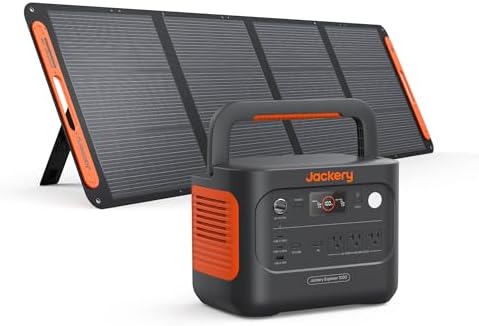
- Powerful yet Compact: Boasting a 1,500W AC output and a 3,000W surge peak, the Solar Generator 1000 V2 can power multipl…
- One Hour Fast Charging: Charge your Explorer 1000 v2 Portable Power Station from 0% to 100% battery level in just one ho…
- 10 Year Lifespan: The Explorer 1000 v2 portable power station is equipped with a durable LFP battery, maintaining over 7…
The Jackery 1000 v2 is the one to buy if you’re not sure what to buy, and the bundle is the reason: it ships as a solar generator, panel included, so there’s nothing else to research. 1070Wh covers an evening outage or a weekend of camping, 1500W of AC output runs everything short of heaters and kettles, and the 100W USB-C port fast-charges laptops directly.
The v2 generation matters. It moved to LiFePO4 chemistry, which survives roughly 4,000 charge cycles instead of the ~500 of older lithium-ion units. Charged and drained daily, that’s a decade of service; used for occasional outages, it will outlive your interest in it. It also picked up the one-hour fast charge from the wall, which used to be a premium feature.
Pros
- Complete kit: portable power station plus 200W panel in one purchase
- LiFePO4 battery rated for ~4,000 cycles
- Light enough to carry to a campsite with one hand
- 1-hour wall recharge when you’re prepping ahead of a storm
Cons
- 1500W ceiling rules out kettles, microwaves on high, and space heaters
- 1070Wh won’t carry a fridge through a long outage
- One 200W panel recharges it in ~6 sunny hours, weather permitting
Best for: first-time buyers, campers, and evening-length outages.
👉 Check the Jackery 1000 v2’s current price on Amazon
2. EcoFlow DELTA 3 Classic (1024Wh)

- Power for Every Scenario: EcoFlow DELTA 3 Classic delivers 1800W output (3600W surge) with X-Boost technology—enough for…
- Ultra-Fast Charging: Go from 0–80% in just 45 minutes with X-Stream AC charging. Keep your devices and appliances powere…
- <10ms UPS: Protect sensitive electronics like PCs, servers, and medical devices. DELTA 3 Classic automatically switches ...
On paper the DELTA 3 Classic and the Jackery 1000 v2 are twins: both ~1kWh, both LiFePO4, both fast-charging. The difference is where EcoFlow spent the budget. You get 1800W of output instead of 1500W, which is the difference between “most appliances” and “almost everything,” and EcoFlow’s X-Boost mode stretches that further for resistive loads like heaters. No solar panel in the box, though: this is a power station, not a solar generator bundle, and the panel is a separate purchase.
The one-hour wall recharge deserves a mention in daily life, not just emergencies. A unit that refills during lunch changes how you use it: run power tools off it in the yard all morning, top it up while you eat, keep going. Slow-charging units become furniture between uses; this one keeps working.
Pros
- 1800W output from a 1kWh unit runs appliances its rivals can’t
- Roughly one hour from empty to full on wall power
- LiFePO4 longevity, same ~4,000-cycle class as the Jackerys
- Usually priced aggressively against the equivalent Jackery
Cons
- No panel included; budget separately if you want solar charging
- Fan noise under heavy load is noticeable, a known EcoFlow trait
- Same 1kWh tank limit as the Jackery 1000: an evening, not a day
Best for: buyers who want maximum output and recharge speed per dirham and already have (or don’t need) solar.
👉 Check the DELTA 3 Classic’s current price on Amazon
3. Jackery Explorer 2000 v2 (2042Wh)

- High-Capacity Power Solution: With 3 AC ports delivering a total output of 2200W and a massive 2042Wh capacity, the Jack…
- Smallest & Lightest 2kWh Power: Weighing just 39.5 lbs, the Jackery Explorer 2000 v2 weighs less than other bulky units,…
- Ultra-Fast & Versatile Charging: Power up and go — Charge the Explorer 2000 v2 from 0 to 80% in just 66 minutes with AC …
The Explorer 2000 v2 is what the sizing math recommends for most households that experience real outages. 2042Wh runs the fridge-router-lights-laptops bundle from dinner to breakfast, and the 2200W output handles a microwave or a washing machine cycle when needed. Jackery kept it deliberately compact for its class: this is the largest unit here that still moves like luggage instead of furniture.
It’s sold as the station alone. Add panels later if you want them; the input supports fast solar charging when you do. For a lot of buyers this is the right order of operations anyway: buy the battery for this winter, add solar next summer.
Pros
- 2042Wh carries a household’s essentials overnight
- 2200W output leaves almost nothing off-limits
- Compact and single-person portable for a 2kWh unit
- 100W USB-C PD keeps laptops charged without touching the AC ports
Cons
- No panel in the box
- Heavier than the 1kWh pair; portable, but you’ll feel the stairs
- Overkill if your outages are measured in minutes
Best for: households with overnight outages, RV weekends, and anyone who did the watt-hour math and got a number near 2000.
👉 Check the Explorer 2000 v2’s current price on Amazon
4. Jackery HomePower 3000 (3072Wh + two 200W panels)
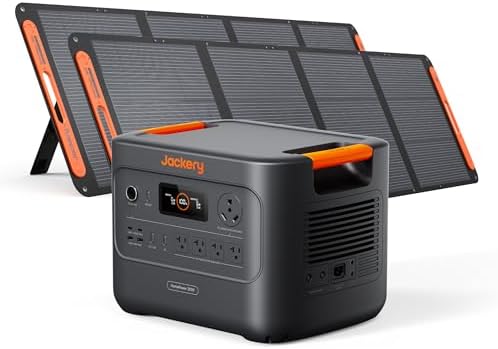
- Essential Home Backup: With a robust 3600W output (7200W surge) and a 3072Wh capacity, the Jackery HomePower 3000 provid…
- ≤20ms UPS: Featuring a UL-certified UPS that switches seamlessly within ≤20ms, the Jackery HomePower 3000 Portable Power…
- Power for Essentials: The Jackery HomePower 3000 keeps your essentials charged at once with versatile AC, USB-C, USB-A, …
The HomePower 3000 stops pretending to be camping gear. 3072Wh of LiFePO4, 3600W of output with a 7200W surge rating, and two 200W panels in the box: this is a home-backup power station that happens to have wheels-adjacent portability. The surge number is the quiet hero, because motors (fridge compressors, pumps, AC units) briefly demand two or three times their running wattage at startup, and 7200W of surge headroom is what lets a power station start them instead of tripping.
The two bundled panels give it ~400W of solar input, which in practical terms means a sunny day puts most of a full tank back in. That’s the threshold where a solar generator becomes an off-grid system rather than a battery you refill from the wall: multi-day outages stop being a countdown and start being a routine of sun in, power out.
Pros
- 3072Wh + 400W of solar covers multi-day outages
- 3600W/7200W surge starts compressor loads other units can’t
- Complete kit with two panels included
- LiFePO4 cycle life makes daily solar cycling realistic for years
Cons
- The price is a home-infrastructure decision, not an accessory purchase
- Heavy; it lives where you put it and travels by car, not by hand
- Two panels want real space: a balcony, terrace, or yard with sun
Best for: serious home backup, frequent or long outages, and off-grid setups where solar does the daily work.
👉 Check the HomePower 3000’s current price on Amazon
Side by side
| Feature | Jackery 1000 v2 | DELTA 3 Classic | Explorer 2000 v2 | HomePower 3000 |
|---|---|---|---|---|
| Capacity | 1070Wh | 1024Wh | 2042Wh | 3072Wh |
| AC output | 1500W | 1800W | 2200W | 3600W (7200W surge) |
| Battery | LiFePO4 | LiFePO4 | LiFePO4 | LiFePO4 |
| Panels included | 1× 200W | ✗ | ✗ | 2× 200W |
| Fast wall charge | ~1 hr | ~1 hr | Fast | Fast |
| Runs a fridge | ~6 hrs | ~6 hrs | ~12 hrs | ~20 hrs + solar |
| Check price | Amazon | Amazon | Amazon | Amazon |
Which portable power station should you buy?
Trust the watt-hour math over the marketing. If your outages are evening-length or the unit is mostly for camping, the Jackery 1000 v2 bundle is the cleanest single purchase: portable power station, panel, done. If you’d rather have more output and a faster recharge than a bundled panel, the DELTA 3 Classic is the better machine for the same tank size.
Real overnight outages point at the Explorer 2000 v2, which is the sweet spot of this lineup for most homes: enough tank to matter, still portable, priced below the flagship tier. And if power cuts at your place are a lifestyle rather than an event, the HomePower 3000 with its bundled panels is the only one here that turns sunshine into a routine instead of a rescue.
One buying tip that applies to all four: a portable power station is the wrong place to save money on a no-name brand. You’re buying a large lithium battery that lives in your house. Jackery and EcoFlow have the safety track record, the certifications, and the warranty infrastructure, and that’s worth more than the discount on a brand you’ve never heard of.
FAQs
Is a portable power station better than a gas generator?
Different tools. A power station is silent, fumeless, and safe indoors, which a gas generator never is. Gas wins on unlimited runtime as long as you have fuel. For apartment dwellers and anyone who wants backup power inside the home, the battery is the only safe option; for powering a whole house for a week, gas still rules.
What does LiFePO4 mean and why does it matter?
Lithium iron phosphate, a battery chemistry that trades a little weight for a lot of lifespan and thermal stability. Where older lithium-ion packs faded after ~500 full cycles, LiFePO4 units are rated around 4,000 cycles before dropping to 80% capacity. All four units here use it, which is why all four are worth considering at all.
How long will these run a refrigerator?
A modern fridge averages 100-200W. Call it 150W: the 1kWh units manage about six hours, the Explorer 2000 v2 about twelve, and the HomePower 3000 about twenty, longer with panels catching sun during the day. Opening the door less helps more than people think.
How fast does solar actually recharge these?
Divide capacity by real panel output, which is 60-80% of the rating in good sun. A 200W panel delivers ~140W in practice, so the Jackery 1000 v2 refills in a long sunny day. The HomePower 3000’s two panels bring that same day’s harvest to ~2000Wh+. Clouds change everything, so treat solar as replenishment, not as an on-demand charger.
Can I fly with a portable power station?
No. Airlines cap lithium batteries at 100-160Wh, and every unit here exceeds that by an order of magnitude. They travel by car, and in summer, not in a hot trunk for days at a time.
Should I store it fully charged?
Store LiFePO4 units at 50-80% for long idle periods and top them up when a storm is forecast; the one-hour fast charging on these makes that practical. Check the charge every three months. A backup battery you never maintain has a way of being empty on the one night it mattered.